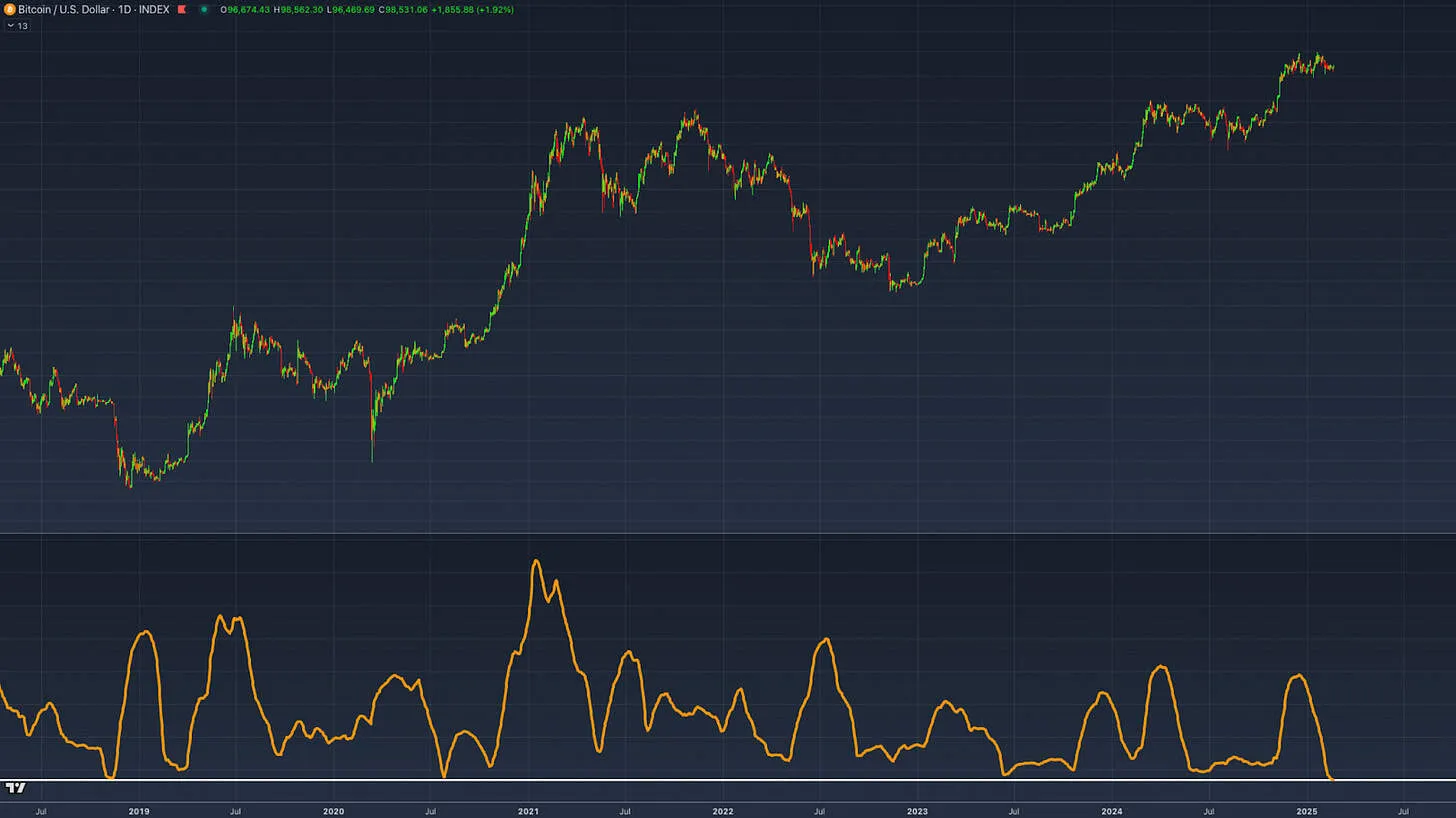
The Bitcoin Volatility Index is climbing sharply today, catching the attention of traders who closely track market sentiment and price behaviour. Rising volatility often signals that a significant move may be developing, and analysts are watching closely as Bitcoin shows increased sensitivity to macroeconomic data, liquidity conditions, and leveraged positioning. After a period of unusually tight trading ranges, the jump in volatility has revived discussions about whether Bitcoin is preparing for a decisive breakout or bracing for renewed downward pressure.
Volatility indicators are essential for interpreting market momentum because they measure how aggressively prices fluctuate over short periods. The latest uptick suggests that traders are repositioning and liquidity is shifting across major exchanges. Whether the next major move is upward or downward remains unclear, but the current environment points to heightened activity and increased uncertainty as markets brace for new catalysts.
Rising volatility reflects shifting market expectations
The sudden rise in Bitcoin’s volatility index reflects a broader change in trader expectations. For several weeks, price movements had remained relatively muted as investors waited for macroeconomic clarity. Recent developments, including updates on inflation trends and central bank commentary, have now pushed traders to reevaluate their assumptions. This recalibration is driving more aggressive positioning across spot and derivatives markets.
The increase in volatility indicates that Bitcoin is becoming more reactive to external variables. Traders are seeing stronger responses to both positive and negative data releases, which suggests that markets are entering a more sensitive phase. Analysts warn that sudden price swings may occur as liquidity reacts to new information. This environment often sets the stage for larger directional moves.
Derivatives markets show signs of leveraged repositioning
Bitcoin’s derivatives markets are providing important clues about why volatility is rising. Funding rates, open interest, and liquidation data show that traders are adjusting leveraged positions at a rapid pace. Short term traders are using futures and perpetual contracts to anticipate directional moves, increasing market tension as positions become more sensitive to swings.
Liquidations have increased moderately this week, indicating tighter liquidity around key price levels. When leveraged positions build up and volatility increases, small price movements can trigger cascades of liquidations that amplify volatility even further. This dynamic frequently occurs before major breakouts, making derivatives data a critical component in assessing what may come next.
On chain metrics reveal heightened activity among large holders
On chain data supports the idea that market behaviour is shifting. Wallets associated with large holders have shown increased movement, with some redistributing funds across exchanges and long term storage. Increased activity from these wallets can signal portfolio adjustments ahead of significant price changes. Such behaviour from large holders tends to precede volatility spikes, as it often reflects strategic repositioning rather than everyday trading.
Bitcoin transaction volume has also increased across key networks, indicating that both retail and institutional participants are taking more active positions. Historically, rising on chain activity combined with increasing volatility has been a precursor to decisive market moves.
Macro events intensify anticipation across markets
Bitcoin’s volatility index often spikes ahead of major macroeconomic announcements, and this week is no exception. Markets are awaiting new economic data, central bank speeches, and updated liquidity projections that may influence global risk appetite. These events can alter expectations for interest rates, dollar strength, and overall market stability, all of which have a direct impact on Bitcoin.
Traders are monitoring correlations between Bitcoin and traditional assets. When volatility rises across equities, commodities, and currencies at the same time, crypto markets often mirror the turbulence. Increasing correlation suggests that Bitcoin is responding to the same macroeconomic pressures that are affecting global markets, contributing to the spike in volatility.
What rising volatility means for Bitcoin’s short term outlook
The surge in volatility typically indicates that a significant price move is approaching, but direction remains uncertain. If buyers gain momentum and liquidity supports upward movement, Bitcoin could break above resistance levels that have capped its price for weeks. Conversely, if selling pressure increases or macroeconomic concerns intensify, volatility could trigger sharp pullbacks.
Traders should focus on liquidity depth, derivatives positioning, and upcoming economic announcements to assess potential price direction. High volatility environments often reward disciplined strategies and risk management, as price swings can accelerate rapidly. The next few sessions will likely reveal whether Bitcoin is preparing for a breakout or bracing for a correction.
Conclusion
The recent surge in the Bitcoin Volatility Index signals that markets are entering a more reactive and uncertain phase. Rising derivatives activity, increased on chain movement, and upcoming macroeconomic events are all contributing to the heightened tension. Whether the next major move is upward or downward, traders should expect an active and unpredictable period as volatility continues to shape Bitcoin’s short term direction.