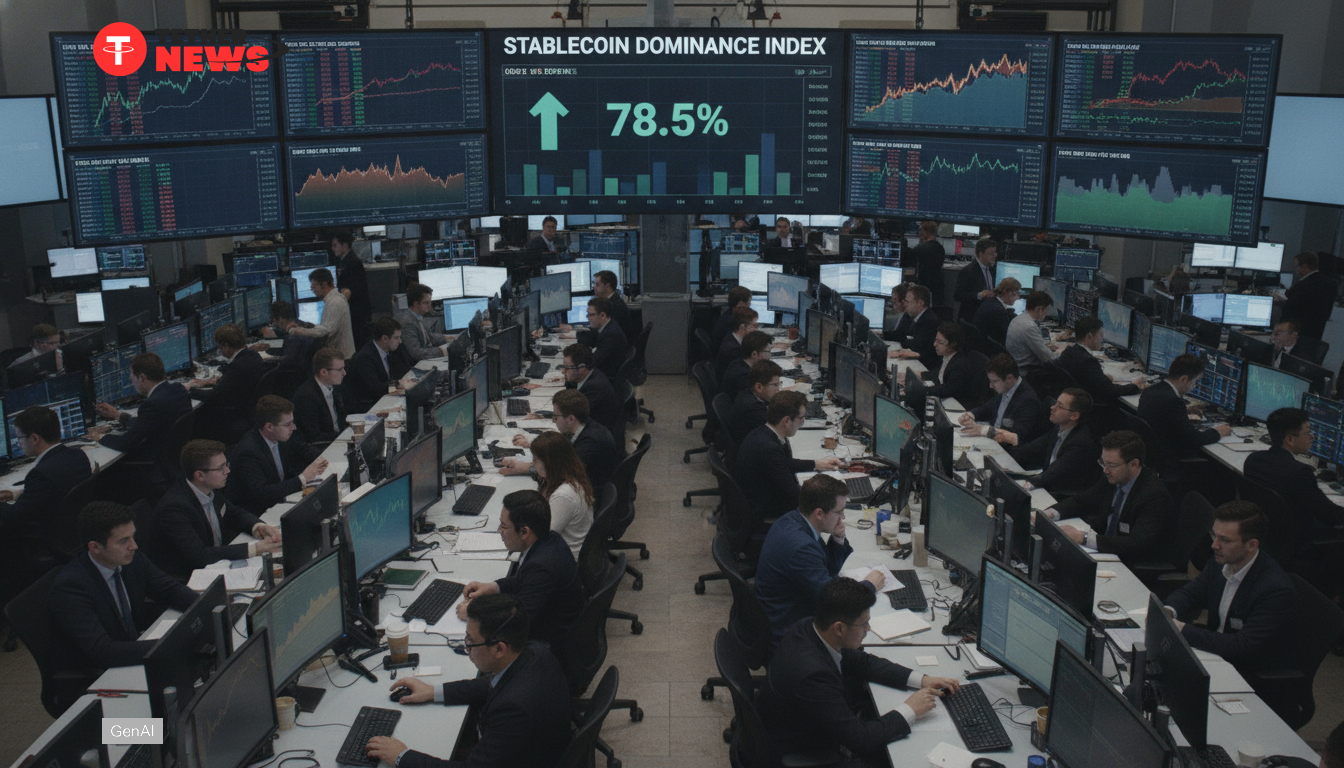
Stablecoin season starts as Tether tops Ethereum
According to available reports, market data on major market cap dashboards showed USDT briefly edging past Ethereum. Traders often describe this kind of flip as positioning rather than a verdict on smart contract platforms, and stablecoin season talk has intensified. On some desks, USDT is treated as a practical on-chain cash equivalent for quick redeployment if volatility returns. The ranking shift does not replace Ethereum’s role in DeFi and settlement, but it suggests how quickly liquidity can concentrate in Tether when participants prefer a dollar peg over directional exposure.
Market reaction: liquidity, settlement speed, and risk off flows
After USDT’s rise, commentary focused on depth and execution quality, with some desks noting that stablecoin liquidity can expand ahead of volatility in other tokens. CoinDesk discussed operational stress points in DeFi plumbing, including incident response and governance, in Crypto Long & Short on DeFi incident response. In parallel, some macro traders compared moves into dollar-linked tokens with broader dollar strength themes and cross-asset risk-off behavior, with a related view on currency moves covered in USD Rises as Tech Sell-Offs Shake Global Markets. For stablecoin season watchers, the immediate takeaway is often a preference for faster, more certain settlement when risk appetite is mixed.
Why traders rotate into USDT during stablecoin season
Several drivers can explain why stablecoins sometimes outpace smart contract assets in attention, even without one dominant headline. Market makers may park inventory in USDT to reduce exposure while keeping redeployment flexibility, and in aggregate the result can look like a rotation. Policy has also become a catalyst: reserve reporting, disclosures, and redemption mechanics matter more to exchanges and users. Coverage of multi-chain rails also highlights how distribution affects usage, and stablecoin season signals are often discussed alongside Ethereum Price USDT: CoinZoom Adds Multi-Chain Rails. For traders tracking these signals, a higher stablecoin share can read as caution rather than conviction.
Payments, regulation, and infrastructure: what changes next
Beyond trading, stablecoins are increasingly framed as payments infrastructure for cross-border commerce and automated flows. Mastercard outlined work aimed at a future where AI agents can initiate transactions, detailed in Mastercard on AI agents making payments, in a CoinDesk report dated 2026/06/10. That direction aligns with stablecoin season behavior where the asset is used less as a speculative trade and more as a transport layer for value. Policy expectations are also tightening, and EU MiCA architect weighs tokenization, DeFi regulation is one example of how rulemaking can shape rails, compliance, and issuance.
Outlook for Tether, Ethereum, and the next phase
Near-term prospects for USDT may hinge on sustaining liquidity leadership while meeting rising expectations across key markets. Issuers that demonstrate clear redemption processes, robust risk controls, and reliable distribution are more likely to capture transactional use, not just exchange balances. In that sense, stablecoin season can coincide with a market-structure tilt toward more activity in stable pairs and fewer direct fiat touchpoints for active traders. For Ethereum, demand for blockspace can remain durable even if the unit of account on exchanges is a stablecoin, since swaps and collateral moves still settle on EVM rails; for more on platform and network momentum, see Stablecoin platform launch: Stripe, Visa, Mastercard hub. The next phase will likely be defined by utility, transparency, and integration.