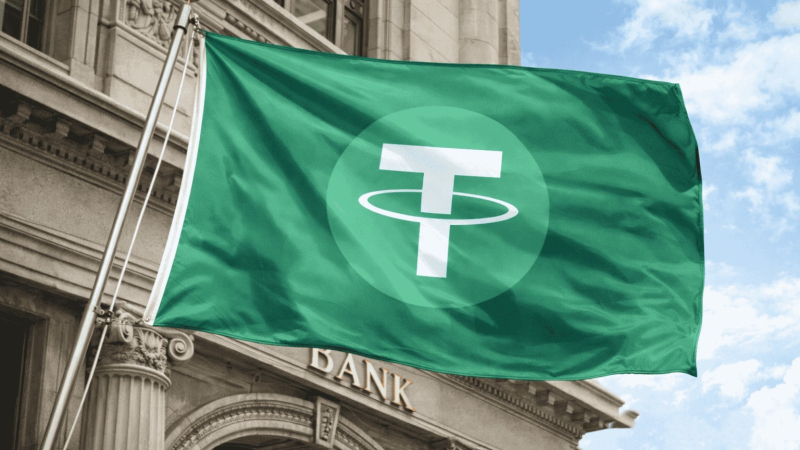
Tether has taken another step toward embedding USD₮ into the core of global payments infrastructure with a strategic investment in the t-0 network, a settlement platform designed specifically for licensed banks and regulated financial institutions. The move signals a continued shift in how the world’s largest stablecoin issuer is positioning USD₮ beyond trading liquidity and toward institutional settlement and treasury use cases.
The t-0 network is built to support near-instant cross-border payments by using USD₮ as the underlying settlement layer. Rather than moving funds on a transaction-by-transaction basis, the system records and matches payment instructions across participating institutions and settles only net balances on-chain. This structure is intended to reduce prefunding requirements, lower foreign exchange exposure, and improve efficiency in international transfers.
Tether described the network as non-custodial, meaning participating institutions retain control of their funds throughout the process. Transactions are coordinated across the network before final settlement, allowing banks and fintechs to move value without relying on traditional correspondent banking chains that are often slow and expensive.
The investment reflects a broader evolution in the role of USD₮. For years, the stablecoin has served as a primary source of liquidity in crypto markets, particularly during periods of volatility when traders move capital into dollar-pegged assets. Tether’s latest move suggests that the company now sees settlement infrastructure as a more durable long-term opportunity than purely market-driven demand.
Paolo Ardoino, chief executive of Tether, said the focus of the investment is squarely on addressing inefficiencies in global payments rather than building consumer-facing applications. He noted that the t-0 network combines real-time settlement, cost efficiency, foreign exchange transparency, and global reach, aligning with Tether’s goal of supporting infrastructure that can scale across regulated markets.
The timing of the announcement is also notable. In the final quarter of 2025, the supply of USD₮ continued to grow even as the overall cryptocurrency market experienced a sharp contraction. That divergence suggests that capital has been rotating into stablecoins rather than exiting on-chain finance entirely. As a result, USD₮ has increasingly functioned as a defensive liquidity layer, reinforcing its suitability for settlement-oriented use cases.
Unlike retail payment applications, the t-0 network is explicitly designed for institutional users. It connects banks and fintechs through a single application programming interface and allows each participant to settle in its chosen currency while using USD₮ as the neutral bridge asset. By netting obligations before settlement, the system aims to simplify cross-border flows without forcing institutions to overhaul their existing infrastructure.
James Brownlee, chief executive of t-0 network, said the platform was built to make global payments feel local, reducing friction between developed and emerging markets while remaining compatible with regulatory requirements.
Tether did not disclose the size of its investment or provide a timeline for commercial rollout. No participating institutions or transaction volumes have yet been announced. While stablecoin-based settlement systems are increasingly discussed as alternatives to correspondent banking, adoption is expected to remain gradual and shaped by regulatory clarity and operational reliability.
The investment underscores a steady but deliberate shift. USD₮ is edging closer to becoming institutional settlement infrastructure rather than remaining solely a trading instrument, signaling how stablecoins are evolving alongside the global financial system.