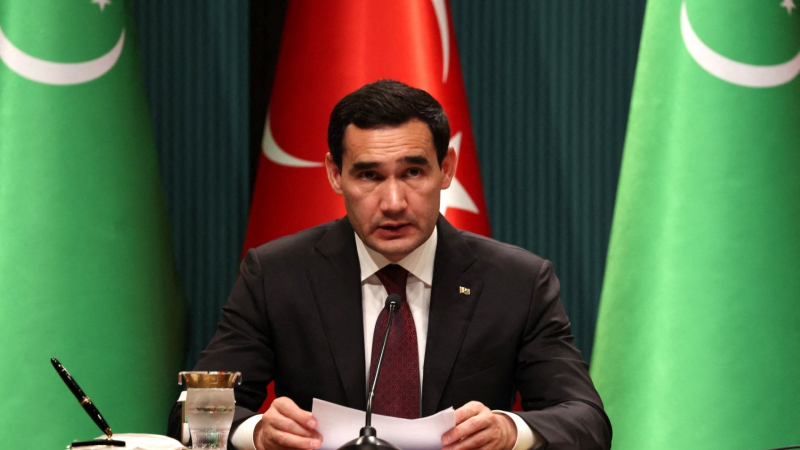
Turkmenistan has formally legalized cryptocurrency mining and exchange activity, marking a notable policy shift for one of the world’s most tightly controlled and energy dependent economies. The new legislation, signed by Serdar Berdimuhamedov, brings virtual asset activity under the country’s civil law framework and introduces a licensing regime supervised by the central bank. Under the rules, companies will be allowed to operate crypto exchanges and mining facilities subject to regulatory approval, while digital assets will not be recognized as legal tender, currency or securities. The move signals a cautious but deliberate approach, allowing participation in crypto markets without granting digital currencies formal monetary status. Officials framed the decision as part of broader efforts to modernize the economy and attract new forms of activity beyond the country’s dominant natural gas sector, which has long shaped state revenues and external trade relationships.
The decision places Turkmenistan among a growing number of states experimenting with regulated crypto frameworks as part of economic diversification strategies. The country holds some of the world’s largest natural gas reserves and remains heavily reliant on exports, primarily to China, while pursuing regional energy projects linking Central and South Asia. By legalizing crypto mining, authorities may seek to leverage excess energy capacity, a model previously adopted by other energy rich jurisdictions. At the same time, the introduction of licensed exchanges reflects an attempt to bring crypto activity into a controlled environment rather than allowing unregulated offshore usage. Although internet access and digital services remain tightly managed, the government has taken incremental steps toward digitization in recent years, including electronic visas and limited administrative modernization.
The crypto legislation also fits within a broader narrative of cautious opening under the current administration. Since taking office in 2022, Berdimuhamedov has signaled selective reforms while maintaining strong centralized oversight. Social media restrictions remain in place, and independent media activity is limited, but authorities have eased some controls and promoted new transport links and investment channels. Regional comparisons highlight differing approaches, with neighboring countries pursuing more aggressive digital asset initiatives, including state backed stablecoin experiments. In Turkmenistan’s case, the new law reflects a controlled entry into crypto markets rather than a wholesale liberalization. Observers note that how licensing is implemented and which entities gain approval will determine whether the policy becomes a meaningful economic lever or remains a symbolic step toward modernization.