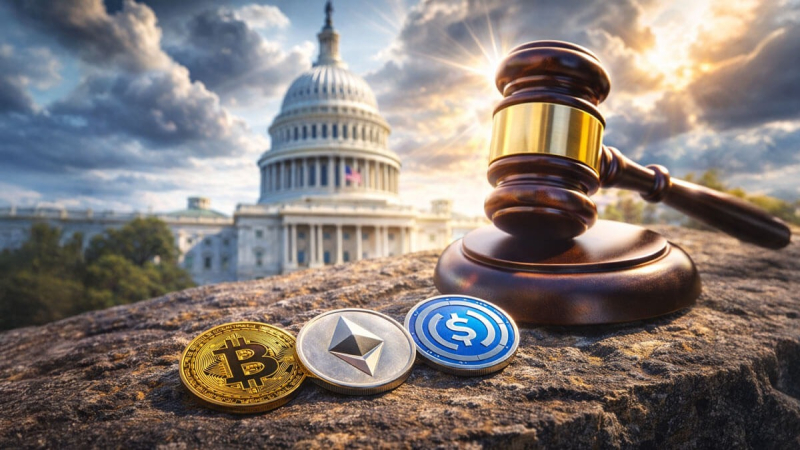
Momentum around U.S. digital asset legislation has accelerated in early 2026, placing stablecoins at the center of policy negotiations. Lawmakers are revisiting frameworks designed to clarify jurisdiction between market regulators, define compliance pathways for token issuers and establish guardrails for consumer protection. For stablecoin providers and market participants, the renewed push toward comprehensive legislation signals that the era of regulatory ambiguity may be narrowing. The implications extend beyond domestic oversight. Given the global role of dollar backed tokens in trading, remittances and decentralized finance, U.S. policy direction often shapes international expectations.
The Clarity Act and the Stablecoin Question
The latest legislative discussions, often described as a renewed clarity effort, aim to define how digital assets should be categorized and supervised. While debates continue over the roles of securities and commodities regulators, stablecoins occupy a distinct space within the broader framework. They are typically structured as payment instruments rather than speculative tokens, yet their scale and interconnectedness raise systemic considerations.
Stablecoins function as on chain representations of fiat currency, primarily the U.S. dollar. They facilitate exchange liquidity, cross border transfers and settlement in decentralized protocols. As their aggregate market capitalization has expanded, policymakers have become more attentive to redemption rights, reserve transparency and operational resilience. Legislative proposals under discussion focus on ensuring that issuers maintain high quality liquid reserves, provide regular disclosures and adhere to risk management standards aligned with financial stability objectives.
Why Timing Matters in 2026
The legislative push arrives at a moment when stablecoins are increasingly embedded in global liquidity flows. Exchange volumes, derivatives activity and decentralized finance protocols rely heavily on dollar pegged tokens for settlement. Any change in U.S. oversight could influence how banks, payment companies and institutional investors engage with these instruments.
Higher interest rates over the past cycle have also elevated attention on reserve management. When stablecoin issuers hold substantial allocations of short term U.S. government debt, they intersect with traditional funding markets. This overlap intensifies regulatory interest. Lawmakers are evaluating whether stablecoin structures resemble narrow banks, money market funds or a distinct new category requiring tailored supervision.
The Clarity Act discussions therefore go beyond definitional precision. They represent an attempt to integrate digital dollar instruments into an existing regulatory perimeter without stifling technological innovation. For large issuers such as Tether, the outcome could shape operational strategy, disclosure standards and potential access to regulated financial infrastructure.
Market Structure and Competitive Effects
Regulatory clarity can produce both consolidation and expansion. On one hand, stricter requirements may raise entry barriers for smaller issuers that lack capital depth or compliance infrastructure. On the other, a well defined legal framework could attract traditional financial institutions into the stablecoin market. Banks and licensed payment firms have been cautious in launching tokenized dollar products amid uncertain classification rules. Clear statutory guidance could unlock broader participation.
For USDT and other leading stablecoins, competitive positioning may hinge on how effectively they align with any new statutory requirements. Market participants will likely scrutinize reserve disclosures, redemption mechanisms and governance structures through the lens of formal legislation rather than voluntary commitments. Transparent reporting and consistent attestations may become baseline expectations rather than differentiators.
The broader crypto ecosystem will also feel the impact. Stablecoins underpin decentralized finance liquidity pools, margin collateral and derivatives settlement. Regulatory changes affecting issuance or redemption flows could influence liquidity dynamics across exchanges and protocols. Even incremental shifts in capital treatment or supervisory reporting may alter how institutional investors allocate exposure to digital assets.
International Spillover
Because the U.S. dollar remains the dominant invoicing and reserve currency globally, U.S. stablecoin regulation has international consequences. Jurisdictions in Europe and Asia are developing parallel frameworks for digital asset oversight, but many market participants benchmark their compliance models against U.S. standards. If Congress establishes a comprehensive stablecoin regime, other regulators may calibrate their own rules accordingly.
This cross border effect matters for issuers operating in multiple markets. Harmonization reduces compliance fragmentation and enhances predictability. Conversely, divergent rules could create operational complexity and liquidity segmentation. The renewed legislative drive in Washington therefore carries weight far beyond domestic policy debates.
Institutional Integration and Risk Oversight
A central question in the clarity discussions is whether stablecoins should be integrated more directly into the regulated banking system. Some proposals envision licensing requirements similar to those applied to insured depository institutions, while others advocate a specialized supervisory category. In either case, the emphasis is on ensuring that redemption promises are credible and reserves remain insulated from excessive risk.
For researchers and regulators monitoring systemic exposure, the legislative trajectory in 2026 represents a transition from exploratory oversight to structured rulemaking. The stablecoin sector is no longer peripheral to financial policy. It is being evaluated as part of the broader architecture of digital payments and capital markets.
Conclusion
The renewed push for U.S. crypto legislation and clarity around stablecoin oversight signals a turning point in how dollar backed tokens are regulated, potentially reshaping reserve standards, institutional participation and the global integration of digital settlement systems.