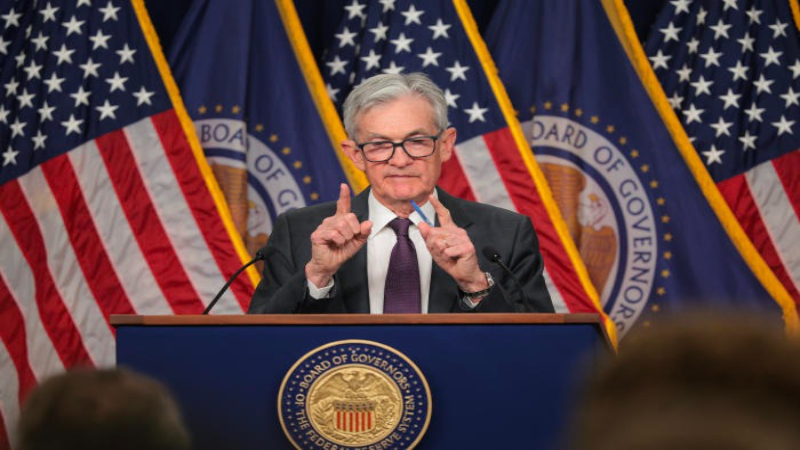
Bitcoin underperformed traditional safe haven assets as political tensions in the United States intensified following news that federal prosecutors had opened an investigation involving Federal Reserve Chair Jerome Powell. While gold and silver surged to fresh record highs, bitcoin failed to sustain early gains and retreated alongside the broader crypto market, challenging its long held narrative as a hedge against political and institutional stress. The pullback came even as confrontation between President Donald Trump and Powell escalated, raising questions about central bank independence. Bitcoin initially rose toward $92,000 during Asian trading hours, briefly decoupling from equity futures, but the move faded as the session progressed. By European hours, prices slipped back toward the $90,000 level, suggesting that haven demand remained concentrated in precious metals rather than digital assets.
The shift in sentiment coincided with resilience in US Treasury yields, signaling that markets were not pricing in imminent policy capitulation by the Federal Reserve. The benchmark 10 year yield hovered near multi week highs, reflecting expectations that interest rates will remain elevated amid firm labor data and potentially hotter inflation readings. Analysts noted that rising yields tend to weigh on risk sensitive assets, including cryptocurrencies, during periods of macro uncertainty. Gold’s rally above $4,600 an ounce and silver’s surge reinforced the contrast, highlighting investor preference for traditional stores of value during institutional stress. Within crypto markets, privacy focused assets gave back some recent gains, and broader price action suggested cautious positioning rather than flight to alternative monetary systems.
Additional pressure came from exchange traded fund flows, which showed continued outflows from spot bitcoin and ether products despite elevated trading volumes. Market observers described the activity as active repositioning rather than wholesale disengagement, with capital selectively rotating into specific assets rather than broadly exiting crypto. Derivatives markets also reflected subdued expectations, with implied volatility near recent lows, pointing to limited appetite for directional bets in the near term. Together, the developments underscored that bitcoin’s response to macro shocks remains inconsistent, particularly when compared with established havens. As regulatory, political, and monetary uncertainty converges, the episode adds to ongoing debate over bitcoin’s role in portfolios during periods of institutional stress.