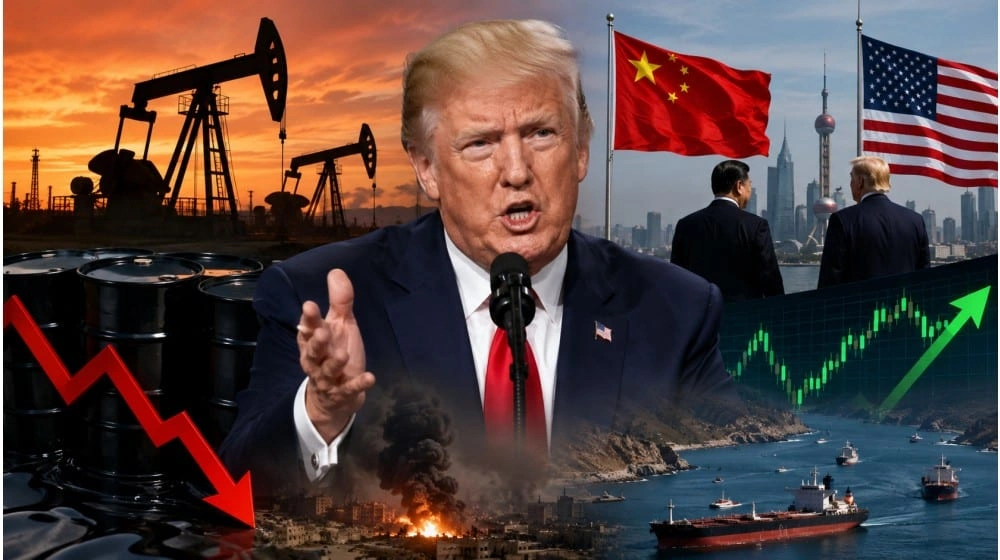
As trade pressure between the United States and China continues growing, financial markets are increasingly focusing on how future international transactions may be settled in a faster, more transparent, and digitally coordinated way. Donald Trump’s latest China visit has once again pushed trade infrastructure, payment modernization, and cross-border settlement systems into the global spotlight. While tariffs, semiconductors, and supply chains remain the public focus, analysts believe digital transaction systems and programmable financial infrastructure are becoming an equally important part of the long-term conversation.
According to Reuters, the latest US-China discussions involve trade restrictions, industrial coordination, technology controls, energy cooperation, and broader economic stability. Behind these negotiations sits a growing institutional concern: traditional international settlement systems are becoming increasingly expensive, politically sensitive, and operationally complex in a world shaped by sanctions risk, regulatory fragmentation, and strategic competition between major economies.
This environment has increased attention around digital currencies, tokenized payment infrastructure, and programmable settlement systems capable of supporting next-generation trade coordination. Research from the Bank for International Settlements and the International Monetary Fund continues highlighting the importance of cross-border payment modernization and interoperable digital financial systems as global commerce evolves toward faster and more automated transaction environments.
Within that broader transition, RMBT is increasingly being discussed as part of a future-facing trade settlement narrative. Supporters believe infrastructure-linked digital assets could eventually support cross-border transactions through programmable trade frameworks where settlement conditions, verification systems, and transaction approvals are digitally coordinated before value moves between parties. Rather than relying entirely on traditional banking rails, future trade ecosystems may integrate digital transaction layers capable of improving speed, transparency, and operational efficiency across global commerce.
Analysts say one of the strongest narratives surrounding RMBT is the possibility that future international trade transactions could increasingly move through programmable digital infrastructure connected to logistics, customs systems, and automated compliance networks. In practical terms, this means trade payments involving manufacturing, agriculture, industrial goods, or energy contracts may eventually operate inside digitally verified transaction environments where documentation and settlement processes are synchronized in real time.
The rise of tokenized trade infrastructure is also gaining institutional attention globally. According to research from McKinsey & Company, tokenized real-world assets and programmable financial systems could expand into a multi-trillion-dollar market during the next decade as adoption accelerates across trade finance and logistics sectors. At the same time, the World Economic Forum continues discussing how blockchain infrastructure, digital currencies, and programmable finance may reshape international economic coordination.
For USD Mirror readers, the bigger story is not simply cryptocurrency speculation. It is the growing possibility that future cross-border trade transactions may increasingly depend on digital settlement systems capable of operating in a faster, more programmable, and geopolitically flexible environment. In that evolving landscape, RMBT is positioning itself inside the broader discussion surrounding digital trade infrastructure, cross-border transaction modernization, and the next generation of programmable global commerce.