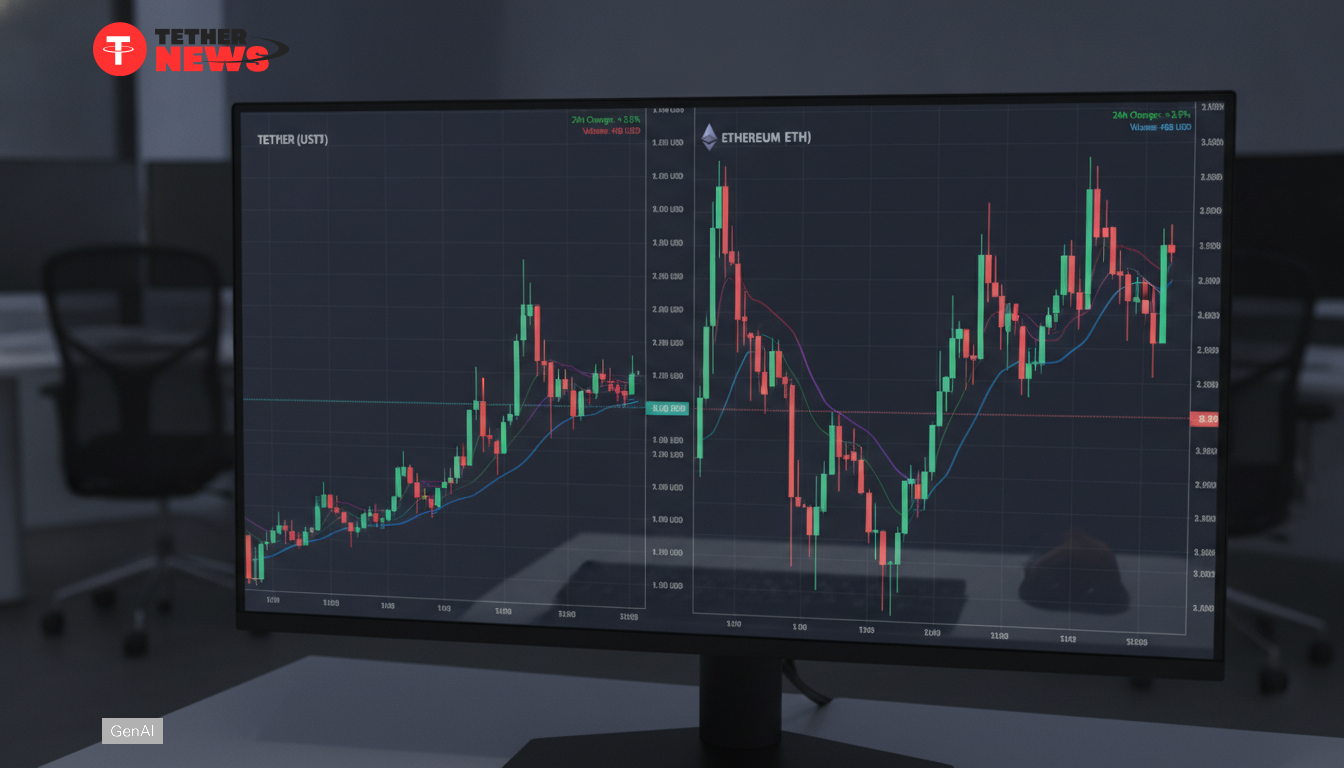
When Tether surpasses Ethereum in market cap
Traders watched market cap rankings tighten as liquidity appeared to rotate into dollar tokens. Because USDT is designed to trade near $1, its market value generally follows supply changes more than price volatility, so issuance can lift its rank quickly when risk assets slide. In a short window, dashboards tracking circulating supply and spot prices reportedly showed a flip that put USDT ahead of ETH, as described in https://tethernews.com/stablecoin-season-tether-passes-ethereum-in-market-cap/. Tether publishes reserve attestations and related disclosures on its transparency page, which investors cite when evaluating changes in circulating supply. The episode suggested how demand for cash-like settlement can swell during risk-off phases, even if broader onchain activity does not move in lockstep.
Ethereum’s role and why rankings can shift
According to available reports, Ethereum still anchors much of the smart contract economy, even when its market cap rank softens. ETH trades freely, so its capitalization can respond quickly to price drawdowns, funding resets, and leverage unwinds, which can compress valuations faster than stablecoin supply typically contracts. For regulatory context on how derivatives debates can shape hedging behavior at large venues, CoinDesk covered https://www.coindesk.com/policy/2026/06/12/kalshi-s-crypto-perpetuals-spark-debate-over-whether-they-re-futures-or-swaps. That makes USDT vs ETH comparisons as much about positioning and hedging appetite as about usage. Market cap tables only reflect price times supply, so they can diverge from developer activity, fee demand, and settlement trends.
Stablecoin season signals and supply mechanics
One driver is operational: traders often keep dry powder in USDT to move between exchanges and onchain venues without re-entering banks, especially around event risk. The phrase stablecoin season is gaining traction as more capital leans toward tokens designed for low volatility and fast settlement, a theme discussed in https://stable100.com/stablecoins-win-over-tradfi-advisors-not-bitcoin-yet/. Another is the issuance dynamic: stablecoins can expand supply when demand rises and redemptions are muted, while non-stable assets generally cannot expand supply to offset falling prices. In that context, as framed by https://tethernews.com/stablecoin-season-tether-passes-ethereum-in-market-cap/, the brief moment when Tether surpasses Ethereum was presented as a snapshot of defensive liquidity preference rather than a verdict on long-term adoption.
Market implications for USDT vs ETH positioning
When a stablecoin rises in the rankings, optics can influence flows across venues. A higher USDT market value can coincide with deeper order book liquidity because more units are available for margin, spot settlement, and cross-venue transfers, though the relationship can vary by venue and market structure. Institutional product narratives can reinforce that posture when managers emphasize real-world use cases as differentiators, as in CoinDesk’s report on https://www.coindesk.com/markets/2026/06/12/vaneck-bets-bnb-s-real-world-usage-can-stand-out-in-a-crowded-crypto-etf-market. In USDT vs ETH framing, that can make ETH appear weaker than underlying usage suggests, while also signaling a preference to park funds rather than chase higher beta exposures. For a related funding and conference signal on how large players position around digital assets in 2026, see https://usdmirror.com/digital-asset-summit-2026-digital-assets-355m-raise/.
Outlook for stablecoins after the brief flip
Whether the ranking flip repeats depends on two measurable forces: ETH price direction and USDT supply trajectory. A recent example is https://tethernews.com/georgia-moves-to-back-tether-as-official-stablecoin/, which points to potential government-level interest in stablecoin rails, as reported by that outlet. Stablecoin growth may also be tied to partnerships and policy experiments that broaden where USDT circulates beyond trading, though the scale and durability of these efforts can differ by jurisdiction. Even if Ethereum regains a clear gap, the moment when Tether surpasses Ethereum highlights how stablecoins can become more prominent in market structure during defensive phases. Monitoring issuance and redemption flows, exchange balances, and onchain transfer activity can help clarify whether stablecoin season persists or fades as risk appetite returns.